Showing posts with label Sun. Show all posts

Sunday, 24 June 2012

When will the sun explode?


This is one of the most common questions thrown to astronomers and scientists. Many of us know that our Sun is a star and a star’s final moment is through a very powerful explosion known as a supernova. This is such a very dreadful scenario; however, the Sun will not experience the same fate as that of the other stars. But how is this possible if the Sun is also a star?

Mass is the deciding factor if a star will explode at the end of its life cycle. To qualify for a supernova ending, the Sun should have a mass that is four times its current mass. Fortunately, its mass will remain unchanged until its end. The Sun has a relatively low mass, thus it is classified as a dwarf star. If it is not going to explode, how it is going to end its life?

Astronomers and scientists predict that in about 5 billion years, the Sun will be depleted of its hydrogen fuel. By that time, the Sun’s gravity will still be powerful to enable the continuous fusion reactions in its core. However, the helium will be turned into carbon, oxygen and nitrogen. Although this is the very same process for a supernova explosion, the Sun does not have enough mass to support an explosive fusion reaction in its core. What will happen is that the Sun will just blow off its outer layers leaving a carbon rich white dwarf core. It will cool down over billions of years until it reaches the very same temperature as with the universe.
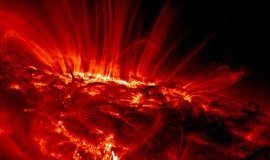
When will the sun explode

Other astronomers theorize that in about 5 billion years, when the Sun has depleted its hydrogen fuel, other gases will be out of control, especially the helium, which shall make all objects here on Earth to melt down and burn.

To read more interesting topics about planets Visit here.

Friday, 13 January 2012

10 Interesting facts about the Sun


White sun
Image of the Sun. Image credit: NASA
We rejoice when we see that the day will be sunny and saddened when the sky is overcast. 

According to studies, cloudy weather for three days, reduces the activity of the brain, and within a week - the general activity of the nervous system. The number of cases of depression cloudy weather increases by four times.
1.We all think that the sun is yellow or orange, but in fact it is white. Yellows Sun gives a phenomenon called "atmospheric scattering."
2.The spectral class of the Sun - G2V, it is closer to the cold end of the main sequence, and belongs to a class of yellow dwarf. Most of the stars in the Milky Way - "red dwarfs" (relatively small and cool stars), and approximately 15% of the stars in a galaxy brighter than our sun.
3.The sun revolves around the center of our galaxy, the Milky Way, making a complete revolution every 225 - 250 million years.
4.Light passes the average distance from Earth to the Sun (150 million kilometers) for 8 minutes. For comparison, the next nearest star, Proxima Centauri is 4 light years away ...
5.Sun has a diameter of about 1.392 million kilometers (about 109 times larger than the diameter of Earth). The mass of the sun is 98% of the mass of our solar system.
6.Between 1640 and 1700 in the Sun did not have spots. This period, called the Maunder minimum, coincided with a "small ice age" - the common cold snap on the Earth, when the river that never freezes, covered with ice, and snow lay all year round at all latitudes. Now the sun is at its peak.
7.The minimum number of eclipses in a year - twice.At any particular point on the surface total solar eclipse occurs on average 1 every 200-300 years.
8.In Malta, the average length of daylight in summer - 10 hours. In Samarkand - 15 hours in Stockholm - 18 hours, and in the Swedish city of Kiruna, located above the Arctic Circle - 24 hours. True, the winter sun in Kiruna, does not arise at all. By the way, dividing the day into 24 hours, we have borrowed from the stories of the ancient Egyptians the god of the sun Ra, who spent twelve o'clock at night in a dark underworld, and the remaining 12 hours - in heaven.
9. 300 sunny days per year is in Morocco, Nice, Brisbane (Australia), in Monte Carlo and Ussuriisk .
10.Every second the sun burns 700 billion tonnes of hydrogen. Despite this tremendous loss rate, solar energy will last another 5 billion years of this life (about the same age from birth the Sun). End his life the sun white dwarf, after having increased in size and alienate all the planets. On these planets, all the water evaporates and disappears atmosphere.